
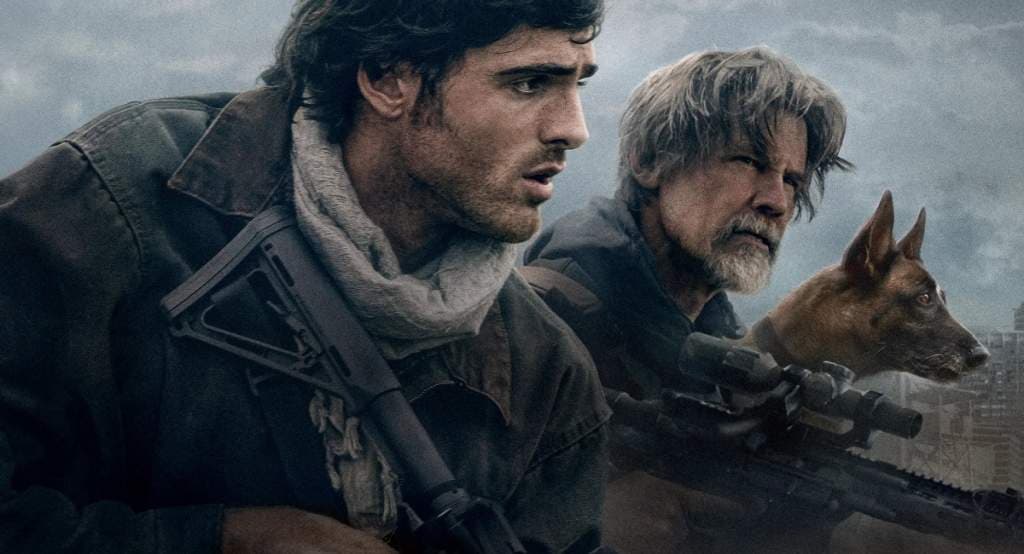
Ridley Scott’s The Dog Stars takes place in a world that has already lost almost everything. A devastating pandemic has destroyed civilization, leaving scattered survivors across a largely empty American landscape. Hig, played by Jacob Elordi, lives at an isolated airport in Colorado with his beloved dog Jasper and the heavily armed survivalist Bangley, played by Josh Brolin. Their relationship is built around a simple but difficult arrangement: Hig wants to believe there is still goodness in people, while Bangley believes trusting strangers is a fast way to die.
Everything changes when Hig picks up a mysterious radio transmission. That signal becomes more than just a possible message from another survivor. For Hig, it becomes a reason to leave the protected world he has built around himself and search for something he has almost forgotten how to want: connection.
The movie eventually introduces Cima, played by Margaret Qualley, and her father Pops, played by Guy Pearce. Their arrival changes Hig’s understanding of what survival actually means.
You May Also Like
The Secret Woman (2026) Ending Explained: Is Louise Actually Helene? Edmund’s Secret Revealed
The Whisper Man (2026) Ending Explained: Who Is the New Whisper Man? Is Jake Alive?

Grand Theft Auto VI Extended Look (GTA 6) Ending Explained: Is Lucia Alive? What Happens to Jason?
Where Was The Whisper Man 2026 Movie Filmed? All Shooting Locations
But the movie’s final stretch raises several major questions.
Is Hig alive? Does Cima survive? What happens to Bangley? Why does Jasper die? What is the meaning of the final scene? And does Hig actually find the future he was looking for?
Here is the full The Dog Stars ending explained.
Why Does Hig Leave His Safe Life Behind?
For much of The Dog Stars, Hig is technically surviving. He has shelter. He has weapons. He has an aircraft. He has food and supplies. He has Bangley. And, most importantly, he has Jasper. But surviving and living are not the same thing. That distinction is at the heart of the movie.
Hig has been trapped emotionally by the world that existed before the pandemic. He remembers his wife, his old life and the civilization that disappeared. Jasper is one of the strongest remaining connections to that past. Ridley Scott has emphasized the emotional importance of Hig’s relationship with Jasper, including the fact that Jasper was originally connected to Hig’s late wife.
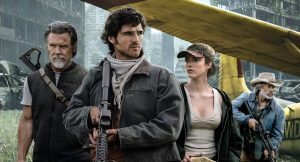
Bangley, meanwhile, represents the opposite philosophy. He believes the safest way to survive is to assume that other people are dangerous. His answer to almost every problem is preparation, suspicion and violence. In a world where resources are scarce and desperate survivors can become predators, his approach makes sense.
Hig is different. He still wants to believe that someone out there might be worth finding. That is why the mysterious radio signal becomes so important. When Hig hears the transmission connected to Grand Junction, he does not simply hear a voice. He hears possibility. Maybe there are other people.
Maybe there is a community. Maybe the world isn’t completely dead. Maybe there is still a future. The journey therefore becomes psychological as much as physical. Hig isn’t simply flying toward Grand Junction. He is flying away from a life in which he has stopped expecting anything better. And that becomes particularly important after Jasper’s death.
What Happened to Jasper? Why Does the Dog Die?
Yes, Jasper dies in the movie.
This is one of the most painful moments in The Dog Stars, especially because the entire emotional foundation of Hig’s character is tied to his relationship with the dog. Jasper isn’t just a companion. He represents loyalty, memory and unconditional affection in a world where almost every human relationship has become dangerous.
Hig can argue with Bangley. He can question strangers. He can distrust settlements. But Jasper never asks Hig to prove himself. That makes Jasper’s death devastating. In the film adaptation, Jasper is killed by marauders. His death becomes a major turning point for Hig, pushing him further away from the isolated existence he has been maintaining. Current post-release coverage confirms that Jasper’s death is one of the major events driving Hig’s decision to continue searching for something beyond the airport.
The death also changes the meaning of Hig’s journey. Before Jasper dies, Hig still has a reason to stay. After Jasper dies, the last major emotional connection to his former life is gone. That doesn’t mean Hig stops loving Jasper.
It means he finally has to decide what comes next. And that is why the movie’s final reference to Jasper becomes so important. Rather than allowing Jasper to disappear completely from Hig’s life, the ending transforms him into a memory that Hig can carry forward.
The stars become a kind of memorial. The loss remains real. But the loss no longer has to prevent Hig from living. That is one of the film’s central ideas: remembering the dead does not mean refusing to build a future.
Who Is Cima and What Happens to Her?
Cima is one of the most important characters in the final part of The Dog Stars. Played by Margaret Qualley, Cima is a survivor and medic who lives with her father, Pops. Her presence introduces something Hig desperately needs: another person who understands loss but has not completely surrendered to it.
Cima has her own traumatic history. She has survived the collapse of civilization, the death and disappearance of people she cared about, and the constant threat of violence. But unlike Bangley, she does not define her entire existence around killing or defending territory. That makes her a natural emotional counterpart to Hig.
Their connection is important because it shows Hig that the world is not simply divided into two categories: people who are dead and people who want to kill him. There are still people capable of caring. There are still people capable of building relationships. There are still people who want something more than survival.
Cima therefore represents the possibility of a new beginning. The movie does not give Hig his old life back. It cannot. His wife is gone. His old civilization is gone. Jasper is gone. But Cima offers something different. She represents a future that Hig hasn’t experienced yet. That difference is crucial. Hig isn’t replacing his old life with Cima.
He is finally accepting that his life can continue in another form. By the ending, Cima survives, and her relationship with Hig becomes one of the strongest signs that the movie is ultimately more hopeful than its bleak setting suggests. The film is not saying everything is fixed. It is saying that life can continue even after almost everything familiar has disappeared.
What Really Happens at Grand Junction?
Grand Junction is one of the movie’s biggest mysteries. For Hig, the radio signal creates an almost mythical image of what might be waiting beyond his isolated airport. The signal suggests that another organized group exists somewhere out there. That possibility becomes increasingly important as Hig loses his previous reasons for staying home.
But when he finally reaches Grand Junction, reality does not match the fantasy. Instead of discovering a perfect refuge or a restored piece of America, Hig encounters another dangerous and unstable survivor environment. The Grand Junction section deliberately destroys the idea that the mysterious signal represents a return to normal civilization.
There is no magical reset button. There is no hidden city waiting to restore the old world. There are simply more survivors trying to determine how to live in a broken one. This is why Grand Junction is ultimately less important as a physical location than it initially appears.
Hig believes he is searching for a place. What he actually needs is a reason to live. The Grand Junction experience forces him to understand that.
The movie also introduces much stranger and more violent elements during this part of the story, making the final act considerably different in tone from the quieter opening sections. Some early viewers have criticized the Grand Junction sequence for feeling rushed and disconnected from the rest of the movie, while others have interpreted it as a deliberately surreal detour in Hig’s search for “home.”
The important point is that Hig does not discover a replacement for the old world at Grand Junction.
Instead, he realizes that home isn’t necessarily a place that survived the apocalypse. Home may have to be rebuilt from scratch.
And that realization leads him back toward the people who matter.
Does Bangley Die? What Happens to Him?
One of the biggest questions surrounding the ending is whether Bangley survives.
Yes, Bangley survives.
His survival is especially meaningful because Bangley begins the movie as the character most committed to the idea that emotional attachment is dangerous.
He is the survivalist.
He is the protector.
He is the person willing to make difficult decisions that Hig doesn’t want to make.
But Hig gradually changes the balance between them. Bangley doesn’t suddenly become a completely different person. He still understands violence. He still understands danger. But by the end, he becomes more willing to accept that survival cannot simply mean keeping everyone else away. This is beautifully reflected in the final reunion.
After Hig and Cima return, Bangley is not waiting for them with his weapon pointed at them. Instead, he is waiting for them with coffee. That small detail matters. In a movie filled with guns, threats and survival tactics, coffee becomes a symbol of ordinary human life.
It says:
You’re home.
Bangley’s transformation is therefore subtle rather than dramatic. He doesn’t give a long speech about becoming a better person. He doesn’t suddenly reject everything he believed. Instead, his actions show that he has accepted Hig’s philosophy enough to allow something resembling a family to develop around them.
Hig, Cima, Bangley and Pops represent something new. Not civilization as it existed before. Not a perfect community. But a small group of people choosing cooperation over complete isolation. That is ultimately Bangley’s victory as well. He survives the physical apocalypse. But more importantly, he begins surviving the emotional one.
Is Hig Alive? What Does the Final Scene Mean?
Yes, Hig is alive at the end of The Dog Stars.
But the more important question is not whether Hig survives. It is what kind of life he chooses after surviving. For most of the movie, Hig is caught between two possibilities.
One possibility is Bangley’s world:
Protect yourself.
Trust nobody.
Stay armed.
Never become vulnerable.
The other possibility is the one Hig keeps searching for:
Find people.
Build relationships.
Risk being hurt.
Try to live rather than simply avoid dying.
The final scenes make it clear that Hig chooses the second path. He doesn’t return to a restored America. He doesn’t find a miracle cure that fixes civilization. He doesn’t magically recover everything he lost. Instead, he returns with a new understanding of what survival can mean.
Cima is alive.
Bangley is alive.
Pops survives.
And Hig has found a new emotional connection. Jasper, however, remains gone. That is why the final reference to the stars is so important. Hig looks toward the sky and connects Jasper with the stars, effectively carrying his memory into the future. The title The Dog Stars suddenly becomes much more emotional.
The stars aren’t just scenery. They represent distance, memory and continuity. Human beings may disappear. Communities may collapse. People may lose everything they built. But memory can survive. And perhaps more importantly, people can choose to create new memories instead of spending the rest of their lives trapped inside the old ones.
The final image therefore isn’t really about whether the apocalypse is over.
It isn’t.
The world is still damaged. Danger still exists. Civilization has not returned. Instead, the ending asks whether humanity itself can survive. And Hig’s answer is yes—but only if people are willing to trust one another again.
The Real Meaning of The Dog Stars Ending
At first glance, The Dog Stars appears to be another post-apocalyptic survival movie. There is a deadly pandemic. There are abandoned buildings. There are weapons. There are marauders. There are isolated survivors. There is a mysterious radio signal. But the movie’s real subject is not the apocalypse.
It is loneliness. Hig has survived the end of the world physically, but emotionally he has been living in the past. His memories of his wife, his old life and Jasper keep him connected to everything he has lost. That is understandable.
But the movie argues that grief can become another kind of prison. Jasper’s death is the moment that finally forces Hig to confront that reality. He cannot bring Jasper back. He cannot bring his wife back. He cannot restore the civilization that existed before the pandemic.
But he can decide whether those losses will prevent him from loving again. Cima becomes part of that answer. Bangley becomes part of it too. Even Pops represents the possibility that older survivors can stop thinking only about defense and begin thinking about community. This is why the ending feels surprisingly hopeful.
It doesn’t promise that everything will be okay. Instead, it suggests that “okay” may no longer mean returning to the world that existed before. Maybe it means creating something new. The film’s official premise describes Hig and Bangley as living in an isolated homestead until a mysterious radio transmission pushes Hig into the unknown in search of hope and humanity. That description essentially contains the movie’s entire emotional journey.
Hig begins the story asking whether anyone is still out there. He ends it understanding that the more important question is whether he is still capable of reaching out. And that is why the ending matters.
Is There a Sequel Setup?
The ending leaves the world open rather than completely resolving it. There is no definitive restoration of civilization. There is no explanation that suddenly fixes every threat. The surviving characters simply continue. That could theoretically leave room for another story, but the ending does not require a sequel to work.
In fact, the movie’s emotional resolution is intentionally smaller. Hig has found people he cares about. He has found Cima. Bangley remains with him. Pops is part of their extended circle. And Jasper’s memory continues through the stars. The world remains broken, but Hig no longer sees that as a reason to stop living. That is the real resolution.
The Dog Stars Ending Explained: Final Verdict
So, is Hig alive?
Yes.
Hig survives the events of The Dog Stars and reaches the ending with a renewed sense of purpose.
Does Cima survive?
Yes. Cima becomes central to Hig’s new life and represents the possibility of love and connection after the apocalypse.
Does Bangley die?
No. Bangley survives and ultimately becomes part of the small community Hig is building.
Does Jasper die?
Yes. Jasper’s death is one of the movie’s most emotional turning points, and his memory becomes an important part of the ending.
What happens to Grand Junction?
It does not become the perfect refuge Hig imagined. Instead, the experience teaches him that the future cannot simply be found—it has to be built.
And what does the final scene mean?
It means Hig has finally stopped trying to recover the life he lost. He is ready to live a new one. The stars represent everything that remains beyond human control: time, memory, distance and the people we can never bring back. Jasper’s presence among the stars allows Hig to acknowledge his grief without allowing that grief to consume him.
That is why The Dog Stars ends not with the restoration of civilization, but with something much smaller and arguably more meaningful:
people choosing each other.
The world may have ended.
But for Hig, life has not.
And perhaps that is the movie’s biggest message: survival keeps you alive, but connection gives you a reason to keep going.
Related – Where Was “The Dog Stars” 2026 Filmed? All Shooting Locations